

In 2026, you can’t avoid mentioning artificial intelligence. Talk to enough vendors and ‘AI-powered’ starts to sound like a badge rather than a capability, which is a shame, because the genuine, deployed, revenue-earning AI kiosk trends are more impressive than the marketing usually manages to convey.
Here’s what AI is really doing to improve the user experience on kiosks today, what’s still maturing, and how to tell the difference when you’re choosing a vendor.

The AI kiosk capabilities that are live right now
Three capabilities across the market have moved from pilot to production. They’re worth understanding on their own terms rather than as one undifferentiated ‘AI kiosk’ pitch.
Personalised upsell prompts. When a kiosk recognises repeat order patterns, time of day, or basket contents, it can generate a relevant add-on instead of a generic “would you like fries with that?” This is rules-based logic layered with machine learning on transaction data, and it’s already earning its keep across QSR and retail, increasing average order value without taking away from employee time, and giving a smoother, more relevant customer experience at the same time.
Dynamic menu and content adjustment. Digital menu boards and kiosk screens that adjust based on stock levels, time of day, weather, or local demand are among the most mature applications of AI in digital signage. A menu that automatically deprioritises an item running low on stock, or promotes a cold drink on a warm day, is useful automation that’s available now. It protects margin, reduces disappointed customers, and removes a manual job.
Predictive maintenance. This is the quieter capability, and arguably the most significant. Remote monitoring software feeding usage and diagnostic data into predictive models can automate flagging of a failing touchscreen, a printer jam risk, or a connectivity issue. For a hospitality group or retailer running multiple kiosks, that’s the difference between a scheduled part swap and a broken unit losing revenue.
Where to set your expectations
Knowing what the technology can’t do is what makes you trust what it can do.
Fully autonomous conversational agents that replace staff end-to-end, kiosks that learn an individual customer’s preferences in real-time across visits with no CRM integration behind them, and emotion detection upsells are all developing quickly, but they belong in the ‘coming soon’ column rather than the ‘proven at scale’ one.
That’s not a reason to wait. It’s a reason to buy on evidence rather than on roadmap slides from vendors.
The adoption numbers point to an opportunity
The industry’s own research tells an interesting story. Kitcast’s State of Digital Signage 2026 report, surveying 515 operators, found that only around 8% currently use AI for content today, while roughly 46% plan to within a year. Broader industry estimates put overall AI integration across signage and kiosk hardware at around 41% in 2026, and the digital signage market itself is projected to grow from $28.8 billion in 2024 to $45.9 billion by 2030.
Essentially, what we are saying is that there is a small window in which deploying AI properly is still a differentiator. The operators moving now are the ones who’ll have a year of real-world tuning behind them by the time the other 46% arrive.
General AI chatbots vs a purpose-built kiosk AI
This is the distinction that matters most, and it’s the one most often brushed over.
A general-purpose assistant like ChatGPT is trained on the open internet. It’s remarkable at broad conversation, but it has no inherent knowledge of your product catalogue, your live pricing, your stock levels, or your policies. Ask it about a specific SKU on your shelves, and it will do what general models do: produce a fluent, confident answer that may be wrong. In a customer-facing retail environment, a plausible-sounding invention about price, availability, or specification can lead to a complaint, a refund, or a breach of trust.
A purpose-built system works the other way round. Rather than knowing a little about everything, it knows your business precisely. It learns from the catalogue, product data, and documentation you already hold, and answers from live data pulled directly from your systems. Crucially, it’s built with anti-hallucination safeguards, so that when a question falls outside what it can verify, it says so or hands over to human staff, rather than filling the gap with something invented.
In simple terms, a general chatbot is designed to always have an answer. A kiosk AI needs to be designed to always have a correct one.
Where LamasaTech stands
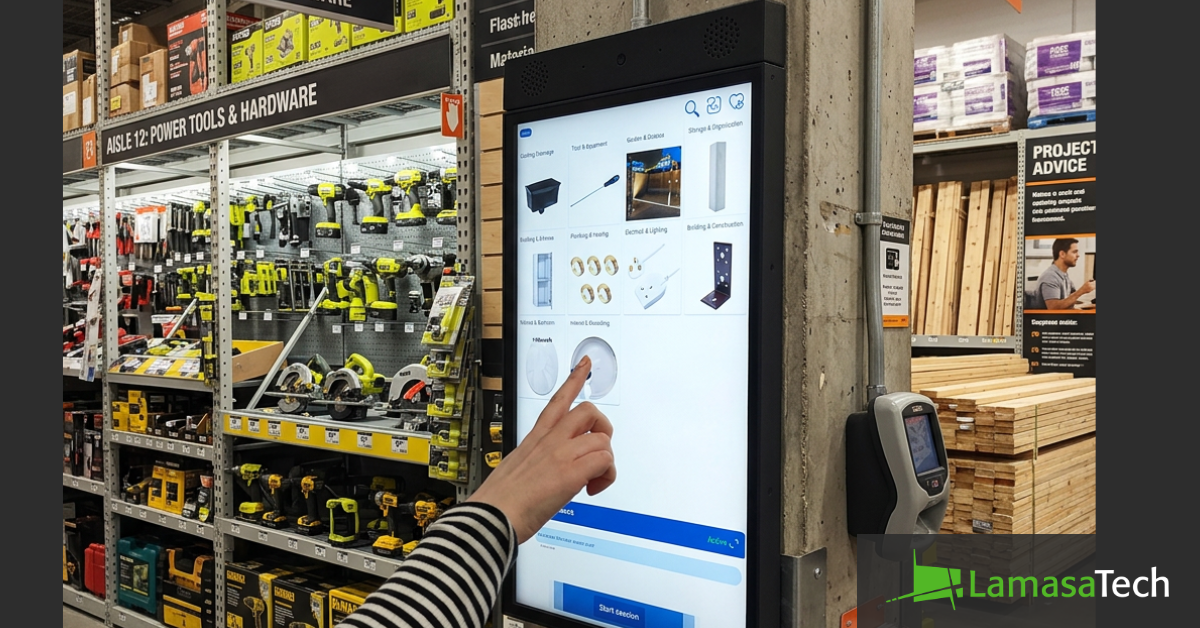
We’ve invested heavily in AI over recent years, and Ravo AI is the result. Our seamless, AI-powered customer service kiosk is built specifically to meet the demand for genuine AI integration rather than retrofitting a chatbot onto existing hardware to tick a box.
Ravo AI is a natural language processing, voice assistant that acts as a product expert and sales advisor. It answers questions out loud using live pricing and stock data pulled straight from the retailer’s ERP, handles multiple languages, and adapts its upsell and cross-sell prompting by product category to improve customer engagement.
Because it’s created from your own catalogue and protected by anti-hallucination safeguards, what it tells a customer is what your systems actually say with no guesswork, no invention.
Should you invest in AI-powered self-service kiosks?
Yes, provided you buy on proof rather than promise.
The questions worth asking a kiosk market vendor aren’t “what AI do you have?” but “which of these features are live and where does the system get its answers from?” Vendors with real deployments will answer those questions comfortably. That’s the conversation about 2026 AI kiosk trends should start with.
If you’d like to see what kiosk AI looks like in practice, we’d be glad to show you Ravo AI in action.